|
|
|
|
Hi Gang!
I trust you're all staying warm and dry!
January 's been painful but gratifying (long hours at the day job managing a film shoot, a sprained back, moved Mom into a lovely new place that specializes in memory care).
Calling the Spirits: A History of Seances continues to move forward through the various editing stages. When you're working with editors to double- and triple-check facts in a large nonfiction book, it can occasionally get tedious, but I'd rather have that than a book with errors. Les Klinger and I have also just completed a final editing pass on Weird Women: Classic Supernatural Fiction by Groundbreaking Female Writers 1852-1923, and we're already talking about our next book.
The first volume of the Horror Writers Association's "Haunted Library of Horror Classics" (The Phantom of the Opera by Gaston Leroux) was just published to rave reviews. During my tenure as President of HWA, I really wanted to do something to bring some of the horror genre's classics back into the public eye, so this series is a dream come true. Each of the first six volumes includes an afterword by me. I couldn't be prouder of this series.
And because February is traditionally Women in Horror Month, I'll be posting a lot of stories by early women horror writers to the site for our Weird Women book, so don't forget to check it out!
Lisa
|
|
Still Life
In which I rhapsodize about favorite movie photos from my collection
|
|
|
I'm cheating this month, because that's not a movie poster.
It's actually the cover of the new Italian edition of my book Ghosts: A Haunted History.
But when one of my friends saw it and said something about it looking like a Lucio Fulci movie, I thought that was oddly appropriate.
So here it is: the best movie poster never made for that obscure Italian horror movie!
|
|
The Halloween Spirit
Tips for keeping it going all year 'round
|
|
|
Sometimes Halloween arrives in the strangest ways.
I recently planted peas in the part of my yard where I grow pumpkins in summer and fall. I read that peas (and beans) were an ideal rotation crop with pumpkins; they give the soil nutrients that pumpkins like, and vice versa.
So I started the seeds indoors, got four nice little pea plants going, transplanted them, they're doing well...and then what do I see after a recent watering?
Something has sprouted next to one of the peas.
It's a pumpkin, probably from a seed I planted there last May that didn't sprout then.
*sigh*
I'm not even sure what variety it is (I grew four different kinds last year), so I guess I'll let it go and we'll see what we get!
|
|
Strange Fruit
The weirdest thing I've recently uncovered in my research
|
|
|
We might not have ghost stories if not for Catherine Crowe.
Catherine Crowe is another of the great unsung women writers of the mid-nineteenth century, and one of the few authors who nearly appeared in both my seance book and my anthology Weird Women. We considered her short story "Round the Fire" for inclusion in Weird Women, but ended up rejecting it because it felt more like a collection of ghost legends than a single short story (and because we already had a number of other ghost stories).
But Mrs. Crowe figures prominently in Calling the Spirits: A History of Seances. She had a hand in two books which were tremendously influential on spiritualism and the ghost story: The Seeress of Prevorst, which she translated from the original German; and The Night-Side of Nature, a collection of ghost lore which sold 65,000 copies in its first year after publication
Mrs. Crowe was also involved in one scandal: in 1854 she was found one night wandering the streets of Edinburgh naked. Media pundits (yes, they had them even then!) said her obsession with spiritualism had driven her mad. She said she suffered briefly from an illness that made her feverish. In either case, she recovered and lived on for several decades (I'd tell you that she died in 1872, but other sources dispute both her date of birth and death).
Both during her life and after her death, numerous spiritualists (and even some anti-spiritualists, like magician J. N. Maskelyne) noted how influential her work had been on spiritualism. But as I noted in the first sentence above, I believe The Night-Side of Nature also inspired many of the ghost stories that came after it.
Thank you, Mrs. Crowe...wherever you are.
|
|
|
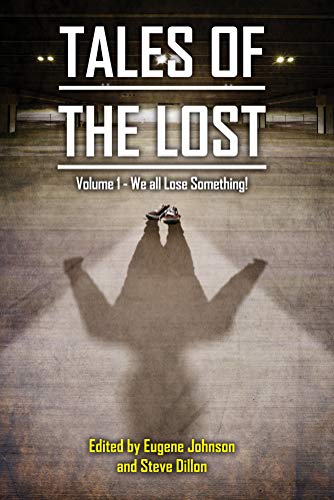
"Unity Endangered" from Tales of the Lost Volume 1
When I was invited into this anthology by co-editor Eugene Johnson, he told me he wanted stories dealing with loss. I knew almost instantly what I wanted to write about:
Homelessness.
I live in L.A., where the homeless problem is epidemic. There are nearly 60,000 homeless people living on the streets of L.A. County. It's a terrible tragedy without an easy resolution. I'm lucky enough to have never gone without a home, but I can see how easy it would be to take one step off the cliff and go into freefall. One health problem...one work accident that leaves you disabled...one property tax payment you can't make, and you could be the next one who's huddled under a freeway overpass trying to hang onto your last few belongings.
Because I'm caregiver to an elderly parent and I know just how hard that is, I decided to make my protagonist someone who gave their life to being a live-in caregiver to a parent, but when that parent dies they're left with nothing. I wanted to make her young and sympathetic, because I think we too often demonize the homeless as junkies or failures. I wanted readers to hope this young woman, named Unity, would get back on her feet, in order to feel her horror when it's revealed that she's fighting against more than living on the street (which is horror enough).
If I could have one reader respond to this story by taking a second look at the homeless in their neighborhood, that would be the ultimate compliment.
|
|
Let's talk advances.
If you're already a traditionally published author, you can skip this month's column; if you're a successful traditionally published author, you can really skip it because money is already flowing to you the way it's supposed to! But for everyone else...
I've recently seen a few comments on social media that made me wonder if advances are something that most people don't have a lot of familiarity with, so I thought I'd give you a crash course here in how they work.
Advances are one of the most important differences between traditional publishing and indie or self-publishing. An advance is money that is paid upfront by a publisher to an author. On a short story, the author will usually be paid one single lump sum for their work, either at the signing of the contract or at publication; on a full-length book, the advance may come in three payments: 1) when the contract between the publisher and author is first signed; 2) when the author delivers the full manuscript; and 3) when the book is published.
Technically, the reason this upfront payment is called an "advance" is that it's really an advance against royalties. What this means to the author is that if the book sells well enough to earn back the advance money and then continues to sell, the author will receive additional money (royalties). The author usually gets a higher percentage of royalties as the book continues to sell (in other words, the author's contract may specify something like 10% royalties on the first 10,000 print copies sold, and 12% after that).
Now, here's where I think maybe confusion sometimes arises: so what if the book doesn't sell enough copies to earn back the author's advance? In fact, what if the unthinkable happens and the book only earns back a fraction of the author's advance?
Here's the important thing to remember: The author does not not have to pay back any advance money received if the book doesn't sell. The only time an author would be required to return any advance money would be if they violate some term of the contract - say, the publisher discovers after the fact that the story was previously published, or plagiarized some other story.
Barring that, though, the author gets to keep the full advance amount, no matter how well the book sells.
Obviously it's in the author's best interest to help promote the book, because you want the book to earn back its advance so you can get more money from royalties.
In other words, this is one big advantage that traditional publishing has over indie or self-publishing: you are guaranteed to see money for your writing.
On the flip side, the advantage with indie publishing is that you are reaping a much higher percentage of the royalties. Instead of the 10%-50% for e-books that you might see with a traditional publisher, you'll probably be getting 70% (I'm guessing you'd be publishing to Kindle via Amazon, and opting for the publishing model that gives you the highest possible royalty, which is 70%). If you're skilled at marketing and promotion and have a product consumers want, you may earn more with royalties via indie publishing than you would have made with an advance from a traditional publisher...but than again, you may not. The advance is a sure thing; the indie royalties are riskier.
|
|
WIP It
My current works-in-progress
|
|
|
My time continues to go to the seance book, with the dreaded job of indexing coming next.
I'm dying to talk about some popping film deals, but the ink is still drying or not yet used, so hang tight.
In the meantime, here's a peek into the publisher's crystal ball (or, rather, their Winter 2020 catalogue):
Calling the Spirits: A History of Séances
Lisa Morton
Calling the Spirits investigates the eerie history of our conversations with the dead, from necromancy in Homer’s Odyssey to the emergence of Spiritualism – when Victorians were entranced by mediums and the séance was born.
Among our cast are the Fox sisters, teenagers surrounded by ‘spirit rappings’; Daniel Dunglas Home, the ‘greatest medium of all time’; Houdini and Sir Arthur Conan Doyle, whose unlikely friendship was forged, then riven, by the afterlife; and Helen Duncan, the medium whose 1944 trial for witchcraft proved more popular than war news.
The book also considers Ouija boards, modern psychics and paranormal investigations, and is illustrated with engravings, fine art (from beyond) and photographs. Hugely entertaining, it begs the question: Is anybody there . . .
|
|

|
|
I was contacted last year by a wonderful artist and writer named Marta Oliehoek-Samitowska and asked to be part of a unique art project: "Horror in the Eye of the Beholder" includes beautiful portraits of the eyes of a number of horror writers accompanied by in-depth interviews. Marta's interview questions were very good (it's always nice when the interviewer has actually read your work), and I can't wait to see/read the complete finished project. Oh, and I'll bet you can spot my eye in the trailer (hint: Marta came up with a distinct clue for me!).
|
|
|
|
|
Trick or Treat: A History of Halloween
|
|
|
My award-winning history of Halloween has just been re-issued in a new less-expensive paperback format!
|
|
|
This new non-fiction anthology of writing tips includes a reprint of my essay "Focus!: How Writers Can Improve Their Productivity."
|
|
|
Tales of the Lost Volume I
|
|
|
Includes my story "Unity Endangered".
|
|
|
I wrote the afterward for this, the first volume in the Horror Writers Association's "Haunted Library of Horror Classics".
|
|
|
This wonderful charity anthology includes a reprint of my story "Black Mill Cove". All proceeds will be donated to the Virginia Beach Tragedy Fund c/o United Way South Hampton Roads.
|
|
|
|
|
Weird Women: Classic Supernatural Fiction by Groundbreaking Female Writers 1852-1923
|
|
|
My Ghost Stories partner Les Klinger and I have re-teamed to dive deep for this anthology of amazing, terrifying stories by early female writers.
|
|
|
Miscreations, which includes my story "Imperfect Clay", is the featured book in the January Night Worms box!
|
|
|
The Lovecraft Squad: Rising
|
|
|
The final volume in this incredible "mosaic novel" includes a chapter by me.
|
|
|
My story "Family" is in this fabulous anthology, coming in June.
|
|
|
Includes my poem "Meeting the Elemental".
|
|
|
|
|

|
|
Are you listening to the free Ghost Magnet with Bridget Marquardt podcast? Each week I provide a "Ghost Report" in which I talk about some cool little bit of history. Plus, there are great guests, and Bridget's a wonderful host!
|
|
|
I don't often write poetry, so I'm especially proud of being included in the sixth volume of the HWA Poetry Showcase. Meaning - I'm simply dying to give one print copy of this away to one lucky winner! Just click the blue button below to enter, and good luck!
|
|
|
|
|
|
|